
Abraham-Louis Breguet the Watchmaker of All Time
Before I could even start this article, I wrote and deleted it countless times. After all, everyone knows Abraham-Louis Breguet, the man I want to talk about today. There are already so many articles written about him, but I still want to share my own take. I’d like to keep it casual, like a friend telling a story to friends, rather than a dry history lesson on a historical figure. I want to show you just how cool this "grand-grandfather" was. If it weren't for him, watchmaking would truly be missing a lot of its classic charm—and perhaps you and I wouldn’t be having as much fun or loving watches the way we do today. So, what are the cool things he left behind? Let’s find out.
Self-winding Perpétuelle: The Birth of the Automatic
In the old days, watches required manual winding, and to ensure they could run for several days, the mainspring barrels were massive. This made pocket watches of that era bulky and thick. So, he calculated a new mechanism from scratch—from the speed of the mainspring release to the length of the spring itself—and created the oscillating weight, or the rotor that we see spinning today in watches with open case backs. The world's first rotor was a platinum disc, and the first functional automatic mechanism was completed in 1780. This first-ever automatic watch was sold to the Duc d’Orléans, a prominent political figure, which helped make both the watch and Abraham-Louis Breguet famous throughout Europe.
Gongs for Repeating Watches: Striking Hammers
High-end watches need to chime the time. In the past, this was done using bells inside the watch. Once again, Breguet wanted to reduce the bulky size of these timepieces, so he reimagined the design, creating a spring that wrapped around the movement to produce a clear, resonant sound, and replacing the bell with metal hammers to strike the time. Usually, watches would only chime every 15 minutes or half-hour, but in true Breguet fashion, he invented a way to chime by the minute. From bells to thin springs—the watchmaking world was astounded and quickly adopted this invention, which has been the standard ever since.
First Shock-Protection: Shock Absorption System
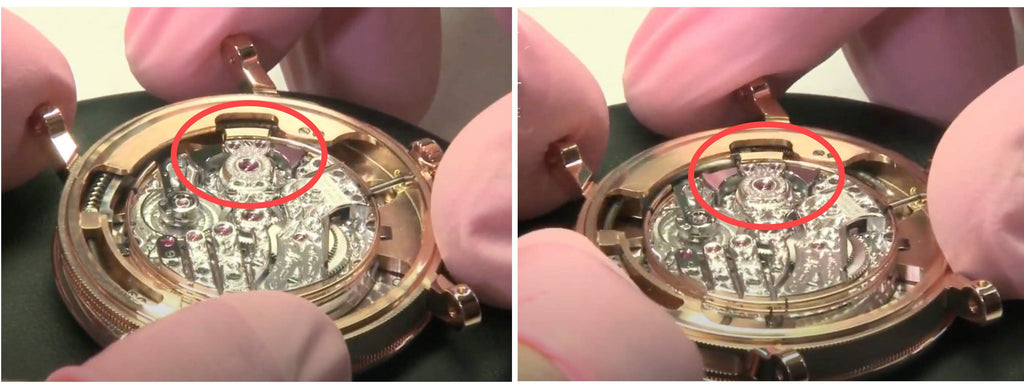
It's not just cars that need suspension systems; Breguet cared deeply about time, and his watches had to be the most accurate. Back then, pocket watches carried in vest or trouser pockets were subjected to significant vibrations from movement. The axis of the balance wheel would be shaken, affecting timekeeping accuracy. Breguet
designed a conical pivot and a cap jewel for the balance wheel, along with the famous Breguet overcoil, to allow the movement to withstand shocks. This resulted in highly accurate timekeeping for Breguet watches. This mechanism is called "pare-chute," which translates to "parachute" in English. 
Even with today's countless innovations, the foundations for automatic movements, shock-protection systems, and repeater hammers still rely on what Breguet invented. Not to mention many other parts, like the Breguet overcoil, which is used so widely today that it’s as if he invented it himself. Every watch likely contains parts born from Breguet’s designs and ideas. From here, let’s take a look at some of the most important watches in Breguet’s history.
Clock No. 178
A Doric column-style table clock made of brass with a silver dial featuring moonphase, day, date, and month indicators, along with a quarter-repeating mechanism. If you owned one, where would you place it? With its look and craftsmanship, we might use it for home decor or on our desk, but this specific piece went much further—Napoleon Bonaparte, the great Emperor of France, bought it for his Egyptian campaign in 1798. It kept him on schedule so he wouldn't miss military plans or assemblies, which were crucial during the war.
The Marie-Antoinette Pocket Watch
A pocket watch that combined every high-end function and craft of that era with an unlimited budget and production time, commissioned by Queen Marie Antoinette. This masterpiece is packed with a minute repeater, perpetual calendar, equation of time, power reserve indicator, metallic thermometer, independent seconds hand, Breguet’s escapement and overcoil, and a double pare-chute shock-protection system. It is considered one of the most complicated watches ever made. It took from 1783 to 1827 to complete, started by Breguet and finished by his son, Antoine-Louis Breguet, four years after the master’s death—and 34 years after the Queen’s death. Today, it is well-preserved in a museum, worthy of its immense value.
Breguet Pocket Watch No. 2667
A Neoclassical style pocket watch with two sub-dials. However, the highlight of this piece is Breguet’s use of "guilloché," a technique of engraving intricate patterns onto materials for decoration. Breguet went all out, engraving the entire case. His purpose wasn’t just aesthetic; the external engraving was meant to prevent the watch from slipping out of the hand. But when he did it, he did it so well that it became a standard for high-end watches, which must feature guilloché. Today, it is one of the requirements for watches seeking the Geneva Seal.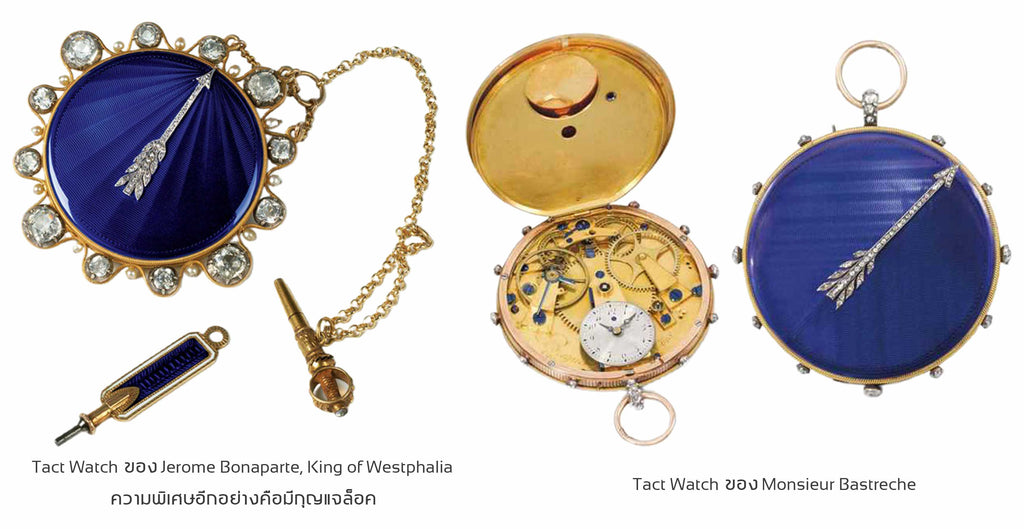
Tactful Watch
Once again, Breguet created something miraculous for the world of horology. In an era where checking a pocket watch meant taking it out and opening the lid to see the time, Breguet thought further: Why open it? And what if it's too dark to see? He made a regular pocket watch but added an arrow on the outside of the lid linked to the internal mechanism, with jewels placed around the case to serve as hour markers and a bow at 12 o’clock. By feeling the position of the arrow relative to the markers, one could tell the time just by touch, without even looking, though the lid could still be opened normally. This watch became known as the "Tact Watch" or "Tactful Watch," perfectly named for this brilliant invention.
The Tourbillon
Finally, we can’t skip the immortal masterpiece of the horological world: the Tourbillon. Breguet was a man of many sciences, including astronomy, and he named his new mechanism "Tourbillon," referring to the orbital movement of stars. The Tourbillon was created to solve the problem of gravity affecting the accuracy of the movement when stored in a pocket. Breguet created what we call a "cage," placed the escapement inside it, and had the whole assembly rotate slowly to negate the pressure of gravity. It is the pinnacle of horological mechanisms and something everyone dreams of owning at least once in their life. 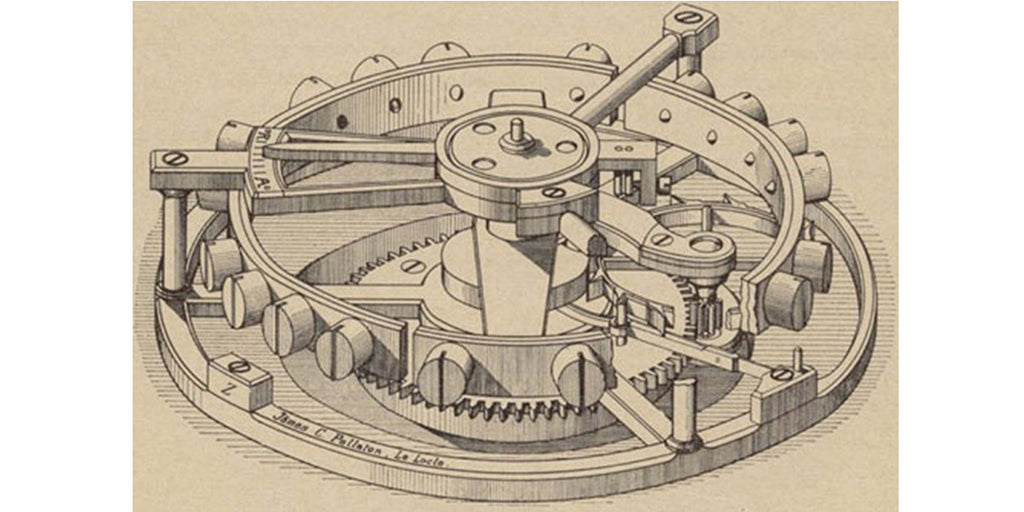
Text from Breguet’s letter applying for the Tourbillon patent.
Quai de l’Horloge No 5.
.
We'll end with a timeline of Abraham-Louis Breguet’s innovations. Hope you enjoyed this story. Bye for now!

++++++++++++++++++++++++++++++++++++++++
🔺 Interested in authentic pre-owned Breguet watches? Click here 🔻
++++++++++++++++++++++++++++++++++++++++
Thank you for all the information from:
- https://www.breguet.com
- https://www.horobox.com
- https://www.hodinkee.com/
- https://www.napoleon.org
- https://www.timeandwatches.com/
- https://www.computissimo.ch
- https://www.jckonline.com
- https://robbreport.com
- http://en.worldtempus.com/
- https://peoplepill.com/people/abraham-louis-breguet