
AP Chronicles Series EP.2: Evolving with the Times – The AP Watch Numeral System
Following our previous discussion on the journey of AP watches—from their origins 147 years ago when Audemars Piguet first inscribed its name into the history of time in the village of Le Brassus, Vallée de Joux, Switzerland, through the year 1951, when the Big Case Number system was introduced to break the limitations of identifying AP watches by Movement Number alone, while also specifying case series paired with independent mechanisms—
however, the story of the AP watch serial number system does not end there. In fact, it underwent change after change before reaching its current form, with each evolution holding fascinating details. Continue reading in this article to find out more.

A Deep Dive into the Big Case Number System
Every AP watch features a number engraved on the case, either on the back, inside, or in both locations. From this point on, we will refer to this as the Big Case Number (in contrast to the small Royal Oak number). For nearly 75 years, the Big Case Number has defined the identity of the Audemars Piguet Royal Oak, as every timepiece is unique, with a movement crafted specifically for it.
In the early 1950s, as the Western world entered one of the most prosperous periods in history, AP watches modernized their production processes. One of these changes was the initiation of the Big Case Number system, allowing collectors to purchase an AP watch that was no longer tied exclusively to its movement number.
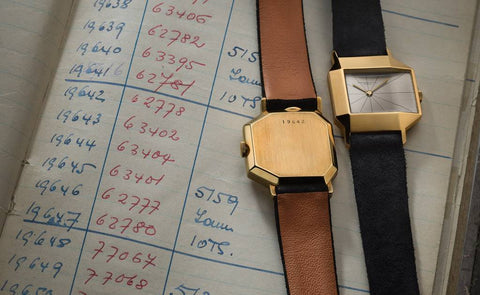
Consequently, since 1951, watch cases with movement 54651 were engraved with the number 101, and subsequent case numbers were assigned incrementally, such as 102, 103, and so on. The manufacturer called these records "Case Registers." By 1975-1976, when the recorded numbers approached the hundred-thousands, AP watches underwent another change, deciding to update the numbering system by adding a letter before the digits. They began with the letter 'B,' as the first 100,000, while lacking a letter, were effectively categorized as 'A.'
The Big Case Number system remained in use until 2017, ending with the 'K' series, before shifting to a random alphanumeric system without sequential ordering. Thus, this system accompanied the Audemars Piguet Royal Oak for nearly seven decades.
The Big Case Number system can be understood via the table below.
|
Large case numbers |
|||
|
From |
To |
Start |
End Approx. |
|
101 |
105393 |
1951 |
1976 |
|
B 1 |
B 99999 |
1975 |
1990 |
|
C 1 |
C 99999 |
1984 |
1995 |
|
D 1 |
D 99999 |
1991 |
2000 |
|
E 1 |
E 99999 |
1998 |
2010 |
|
F 1 |
F 99999 |
2003 |
2010 |
|
G 1 |
G 99999 |
2009 |
2015 |
|
H 1 |
H 99999 |
2011 |
2015 |
|
I 1 |
I 99999 |
2013 |
2020 |
|
J 1 |
J 94000 |
2015 |
2020 |
Model Numbers
Another matter that AP watch collectors should be aware of is the background of model numbers. This again takes us back to 1951, starting with Audemars Piguet craftsmen intending to create two identical watches. Consequently, each watch was described separately in a small, hardbound notebook called the "Registers of Completed Watches" (Registres des Montres Complètes).
However, during the post-WWII boom, increased production and expanded sales made it necessary to rethink these methods. Audemars Piguet decided to produce identical watches in small series. This revolution brought about the concept of model lines, which was a very new idea.
As a result, model numbers were highly effective for increasing sales. For the first time, Audemars Piguet customers could order multiple pieces of the same model! Combined with promotion via catalogs and other promotional media, the brand could connect directly with the end consumer.
A Revolution That Retained Its Identity
It would be incorrect to assume that the shift to the Big Case Number system or model numbers made AP watches common. In reality, every piece remained meticulously handcrafted. Series remained limited, generally produced in batches of 10 to 20 cases or fewer. Furthermore, Audemars Piguet continued to produce a large number of distinct calibers. For example, in 1951, at least 15 different calibers were produced for the sale of approximately 900 watches.
Therefore, this philosophy set the Audemars Piguet apart from other brands of that era, which had transitioned to fully industrial processes. Unlike other watches, AP model numbers only defined the shape and size of the case.
The Birth of New Terminology in Collector Circles
Due to the numerous changes in the serial number system used for AP watches, from the late 1950s onwards, Audemars Piguet classified categories by model number, complexity, and type of timepiece, as follows:

- N° 4000 to 4999: Men's watches, metal bracelet
- N° 5000 to 5499: Older models for men
- N° 5500 to 5599: Complicated watches (pocket watches and wristwatches)
- N° 5600 to 5799: Pocket watches
- N° 5800 to 5999: Older models for ladies
- N° 6000 to 6999: Quartz watches
- N° 7000 to 7999: Ladies' mechanical watches, leather strap
-
N° 8000 to 9999: Ladies' mechanical watches, metal bracelet
5-Digit Reference Codes
In 1970, AP watch production was further structured. Most notably, the establishment of a technical department meant that from then on, in production registers and certain catalogs, references for watch bracelets were added. The meaning of each letter is as follows: "ST" stands for Steel, "BA" for Yellow Gold, "BC" for White Gold, and "SA" for steel mixed with gold. For example, 5002BA means the 5002 model is in Yellow Gold. This system was used until the 21st century.
Audemars Piguet maintained that even for small series of lower-priced AP watches, they had to be handcrafted, or even for single-production items, Audemars Piguet still created hundreds of models. By the early 1980s, it was clear that 4-digit references were no longer sufficient for production numbers. Consequently, Jacques-Louis Audemars and Georges Golay, who were managing the company at the time, decided to increase the reference to 5 digits. Thus, 5402 became 25402, 8638 became 78638, and so on.
This 5-digit code served as the base for expanding and improving AP watch model numbers. Since the beginning of the 2000s, additional codes were gradually provided to give information regarding gemstones, finishing, buckles/clasps, straps, materials, and dials.
Case Material Table
|
Code |
Material |
Code |
Material |
|
AA |
Green gold |
OK |
Pink gold / Rubber |
|
AC |
Yellow gold / White gold |
OL |
Pink gold / Tantalum |
|
AG |
Silver |
OM |
Pink gold / Cermet |
|
AE |
Alacrite |
OR |
Pink gold |
|
AI |
Alacrite / Titanium |
OS |
Forged carbon / Steel |
|
AK |
Yellow gold / Rubber |
PA |
Platinum / Yellow gold |
|
AL |
Aluminium |
PO |
Platinum / Ceramic |
|
AP |
Yellow gold / Platinum |
PM |
Platinum / Cermet |
|
AR |
Yellow gold / Pink gold |
PR |
Platinum / Pink gold |
|
AU |
From 3 materials |
PT |
Platinum |
|
BA |
Yellow gold |
RA |
Pink gold / Yellow gold |
|
BC |
White gold |
RC |
Pink gold / White gold |
|
CA |
White gold / yellow gold |
RO |
Pink gold / ceramic |
|
CB |
White ceramic |
RP |
Pink gold / platinum |
|
CE |
Black ceramic |
SA |
Steel / yellow gold |
|
CK |
White gold / rubber |
SB |
Blue PVD-treated steel |
|
CN |
White gold / ceramic |
SC |
Blue PVD-treated steel |
|
CR |
White gold / pink gold |
SK |
Steel / rubber |
|
FC |
Carbon fibres |
SN |
Black PVD-treated steel |
|
FO |
Forged carbon / ceramic |
SO |
Steel / carbon |
|
FR |
Carbon / Pink gold |
SP |
Steel / Platinum |
|
FS |
Carbon / Steel |
SR |
Steel / Pink gold |
|
IA |
Titanium / Yellow gold |
ST |
Steel |
|
IB |
Titanium / Blue PVD-treated steel |
TA |
Tantalum / Yellow gold |
|
IC |
Titanium / White gold |
TI |
Titanium |
|
IK |
Titanium / Rubber |
TK |
Tantalum / Rubber |
|
IO |
Titanium / Ceramic |
TL |
Tantalum |
|
IM |
Titanium / Cermet |
TP |
Tantalum / Platinum |
|
IP |
Titanium / Platinum |
TR |
Tantalum / Pink gold |
|
IR |
Titanium / Pink gold |
TS |
Steel / Tantalum |
|
IS |
Titanium / Steel |
TT |
Tantalum / Steel |
|
LT |
Brass |
ZI |
White diamond / Blue sapphire setting |
|
OI |
Pink gold / Titanium |
ZO |
White diamond / Onyx Setting |
|
OF |
Pink gold / Forged carbon |
|
|

Small Royal Oak numbers
The Audemars Piguet Royal Oak 5402ST was launched in 1972 and can be considered a revolutionary icon in the watchmaking world. Its design seamlessly blended sportiness with horology, rewriting the codes of Haute Horlogerie in a smaller size. Furthermore, in order to change the numbering system of Audemars Piguet watches to reflect their rarity and value, the brand decided to introduce the Small Royal Oak numbers, which tell the story of individual timepieces.
Simply put, the large case number was moved inside the case, making way for the Small Royal Oak number, which consists of a letter followed by numbers. This system identified each model from A1 to A2000, then B1000 to B2000, and so on, from 1976 until the end of 2010.
Buy authentic AP watches at a great price at Pixiu Watch
Having immersed yourself in the endless history and the charm of timepieces that stand out through the exquisite fusion of AP watches, if you are now looking to own an authentic AP watch at a great price, you must visit Pixiu Watch. We are a pre-owned luxury watch retailer that gathers all precious timepieces, allowing you to discover the perfect charm in the beautiful watch you desire. We are ready to provide professional advice and guidance, as we have long understood the passions of collectors.
For further inquiries, please contact us at 096-939-9292 (Oat), available every day during business hours.
Reference
- Audemars Piguet Heritage team. Le Brassus. AUDEMARS PIGUET WATCH NUMBERING. Retrieved December 23, 2022, from https://apchronicles.audemarspiguet.com/en/article/audemars-piguet-watch-numbering