AP Chronicles Series EP.5: Authentic AP Royal Oak Dials
Welcome to another article in our "AP Watch Journey" series, where we revisit popular pre-owned AP models. We look back at the history of the Royal Oak, a signature timepiece and a hallmark of aesthetic codes since its 1972 debut, featuring dials decorated with the Petite Tapisserie pattern.
This exquisite hallmark is regarded by watch enthusiasts as one of the most refined designs in existence. In this article, we have compiled the techniques and the high-horology design presentation of authentic AP watches, from the original format to the Grande Tapisserie introduced in 1999—a perfect timepiece that remains enduringly popular.

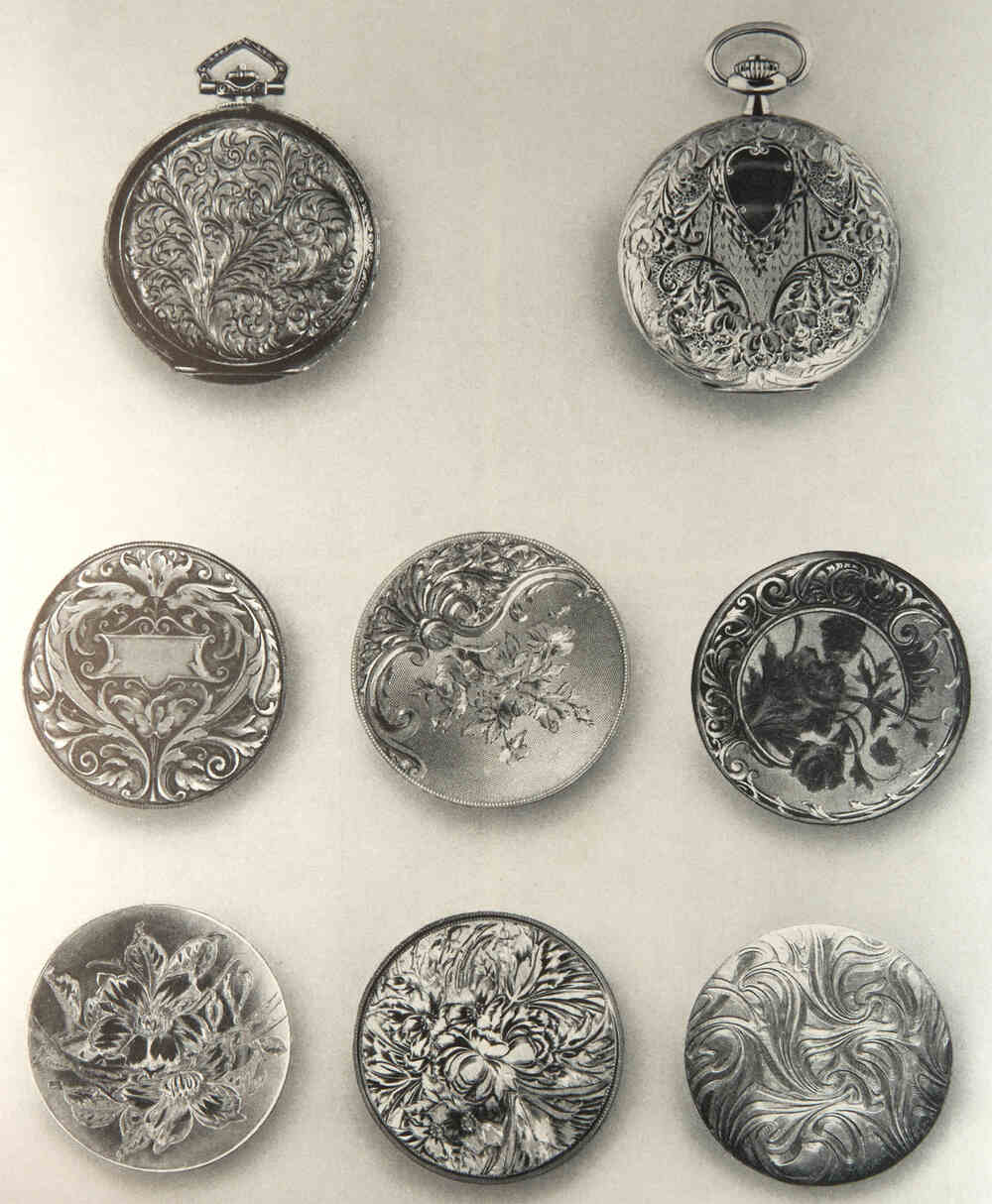
Circa 1900: This is an example of watch decoration using the Guilloché technique, featuring copies of Art Nouveau floral patterns machine-engraved in part, according to the principles that would lead to the Tapisserie technique in 1972 (E. Jaquet and A. Chapuis, Technique and History of the Swiss Watch, 1945, Plate no. 130).
Guilloché Copying Machine: The Origin of the AP Royal Oak's Tapisserie Dial
The Guilloché Copying Machine, the historical origin of the Tapisserie dial on the Audemars Piguet Royal Oak, is a device that transfers high-end engraving designs, with a fate intertwined with the watch since its inception.
The story begins around 1875 in the charming watchmaking town of La Chaux-de-Fonds, about 100 kilometers from the Vallée de Joux and Le Brassus, which were the original sites of Audemars Piguet’s handmade workshops. Over time, prosperity reached La Chaux-de-Fonds; from a small community of watchmakers, it evolved into a major horological metropolis. German scholar Karl Marx even referred to it as a "city of the watch industry" in his book Capital, as one could find every type of workshop there.
By the end of the 1890s, the popularity of pocket watches was unstoppable. Due to increasing demand, craftsmen could no longer compete using manual engraving. To meet this growing need, Robert-Alfred Lienhard produced the first Guilloché Copying Machine in 1895. It was a predecessor to the machine used to produce Royal Oak dials, distinguished by its complexity, as it could decorate every surface of a curved pocket watch.
However, this change was not initially well-received, as some skilled engravers rose up in protest, feeling their livelihoods were threatened by the competition of modern, labor-saving machines. Eventually, they were forced to move away from traditional methods and embrace new ways of working with machinery. Yet, this was not what truly destroyed the role of the engraver; the real culprit was the advent of the "wristwatch era" in the 1920s and 1930s.
As a result, Lienhard’s company had to invent something new to satisfy the massive and exciting demand in the watchmaking industry. They created a simple yet versatile engraving machine, which saw great production success in fields outside of watchmaking. Many of these machines were exported to the United States and Canada, while some remained in Switzerland and were sent to the La Nationale company in Geneva, the capital of watchmaking.

Lienhard Guilloché engraving machines were manufactured between 1950 and 1976 by the Lienhard and Guedel companies, both located in La Chaux-de-Fonds. These were among the dozens of Guilloché engraving machines used in factories across the Atlantic before joining the Audemars Piguet brand in 2010 to apply the Guilloché technique to the dials of authentic, classic AP Royal Oak watches.
Merging Craftsmanship into the Tapisserie Technique
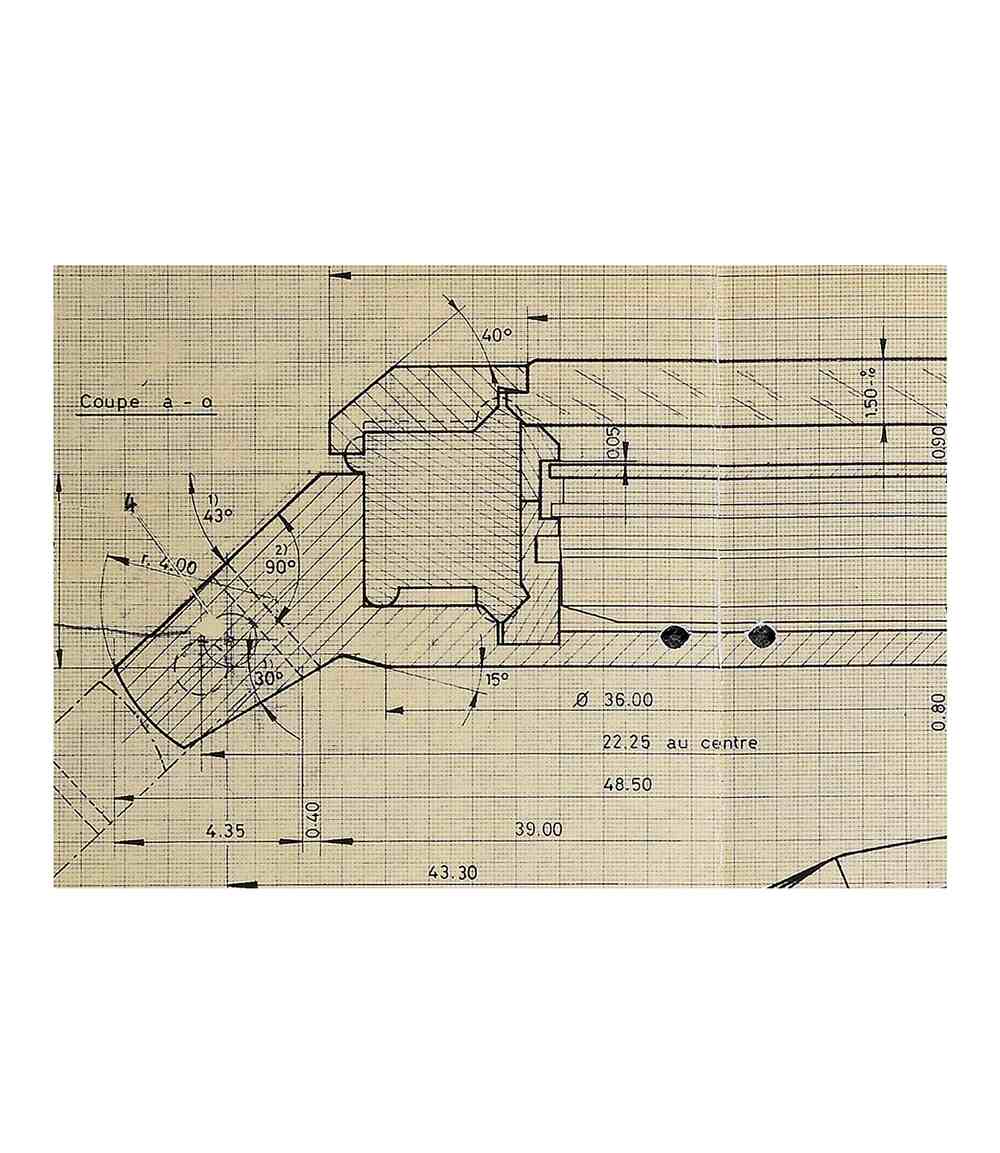
To produce a Tapisserie dial—the kind that watch collectors eagerly seek out in good pre-owned condition regardless of the price—multiple traditional design skills must be combined: engraving, guilloché, and illustration. The most delicate and valuable art is engraving, which has existed for thousands of years alongside sculpture and painting, requiring 'patience' as the core element of creation.
In watchmaking, this art appeared in the early 16th century, used to decorate table clocks, pendants, and much more. It continues to this day, particularly with Audemars Piguet, where it is associated with openworked movements, oscillating weights, and dials modified in various styles.

Examples include the lathe copied from Tsar Peter I in 1718, as well as the guilloché lathe (rose engine) produced by François Houard for Max Emmanuel of Bavaria in 1712. Using these machines, artisans would carve intricate patterns to create stunning effects.
From the 18th century onwards, in France and Switzerland, the Guilloché technique began to be applied to mechanisms and specifically to pocket watch cases. Patterns were "programmed" for the machine to memorize and create small variations in position, becoming defined designs. Abraham-Louis Breguet helped make this art form even more popular in the watchmaking circle, adorning his creations with Hobnail Clous de Paris, barleycorn, or basket-weave patterns.
Another Tapisserie technique is copying. The Illustrated Professional Dictionary of Horology describes it as "a tool for copying drawings mechanically, sometimes enlarging or reducing the size," using articulated arms and a template (also called a matrix/model). The Musée International d'Horlogerie in La Chaux-de-Fonds has an excellent example of a dial with a copying script so small it is almost invisible to the naked eye. Copying machines were also used by Vacheron Constantin from the 1840s onwards to produce small parts with such precision that manual finishing was no longer necessary, thus designing them to be interchangeable.
In summary, the Tapisserie pattern is a combination of these three techniques: engraving, which hollows out the material with a burin; guilloché, which uses a mechanical lathe; and copying, which mimics the design according to the model (matrix or pattern) by adjusting it to the size of the piece. All of these combined result in the priceless creation of an Audemars Piguet watch dial.
The Birth of the Grande Tapisserie: More Modern Refinement
Once again, a new, more generous Tapisserie pattern was created. It is beautiful, refined, and more inclusive. Although the production technique remains the same, the base of the truncated pyramids is twice as large, resulting in a significant reduction in the number of pyramids. Consequently, the authentic AP Royal Oak "Jumbo" dial has a reduced number of pyramids, from the original 680 to 740 down to just 380 in the new Grande Tapisserie format.
In 1999, after remaining loyal to the Basel Fair for over half a century, the brand introduced new Audemars Piguet watches for the first time at the SIHH (Salon International de la Haute Horlogerie) in Geneva. Production began in 1991 for two new models featuring the Grande Tapisserie pattern: the Royal Oak Annual Calendar 25920 and the Royal Oak Time for the Trees 15100, limited to only 450 pieces to support sustainable development projects run by the Audemars Piguet Foundation. Additionally, the 14790 model, hailed as a "classic Audemars Piguet watch in the collection," also features the Grande Tapisserie design.
Over the years, the Petite Tapisserie pattern began to fade from the Audemars Piguet Royal Oak collection. However, its disappearance was far from a "final breath." The Petite Tapisserie finally returned in 2012 to celebrate the 40th anniversary of the Royal Oak with the 15202 model, which has since become another AP watch model highly sought after by pre-owned collectors.
Buy Authentic AP Watches at Pixiu Watch
The story of the journey behind the design technique known as Tapisserie does not end here. You can follow the evolution of the latest dial designs of this technique in the next article. But for those whose passion rests with the AP Royal Oak Jumbo, at Pixiu Watch, we offer them at prices you might not expect. We are a hub for carefully selected and thoroughly inspected pre-owned designer watches, allowing you to own a precious timepiece at a reasonable price. We also provide professional advice and guidance on buying and selling, sincerely welcoming you into our community of watch collectors.
For further inquiries, please contact us at 096-939-9292 (Oat) every day.
References
- Royal Oak Guillochage Tapisserie History. Retrieved June 27, 2023, from https://apchronicles.audemarspiguet.com/en/article/guillochage-tapisserie