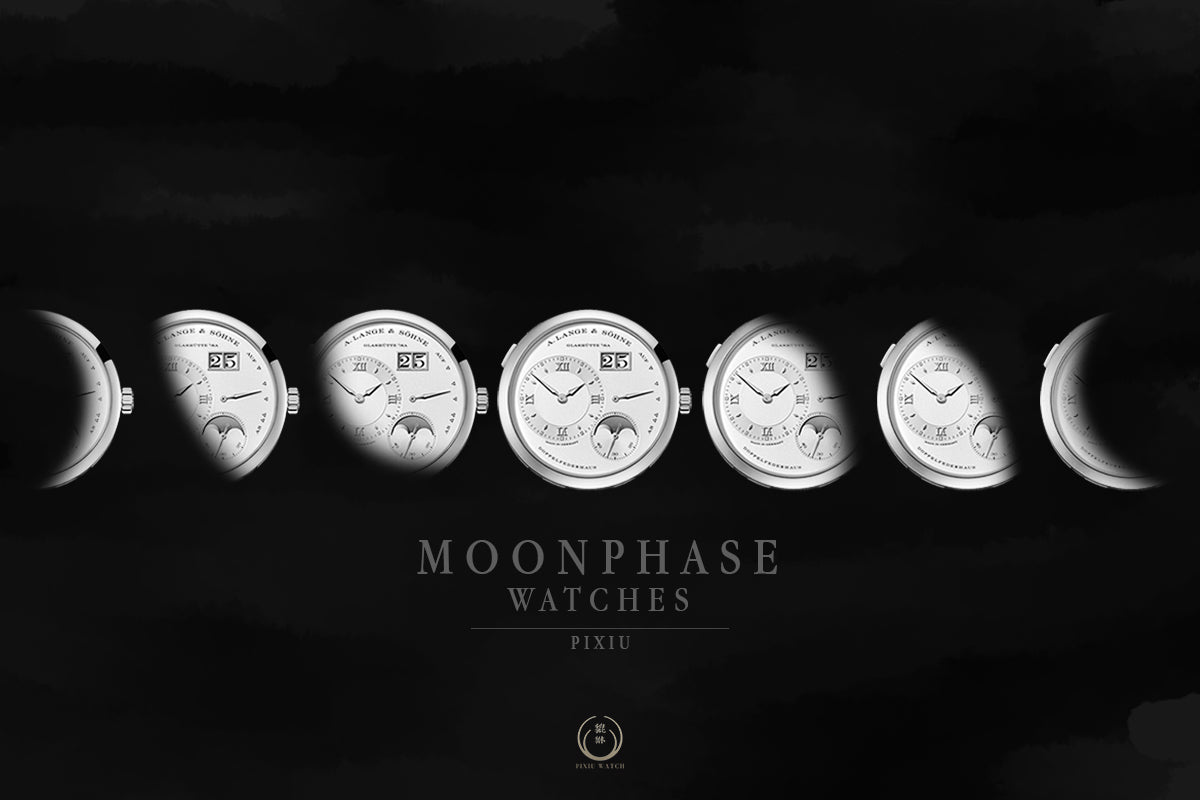
Moonphase Watches

The “moonphase” is a function that very few people actually use. Tracking the 29.5-day lunar cycle every month would certainly be easier via an app or astronomical data on a website, but who actually makes use of the phases of the moon? In the past, stargazers and astrologers used their knowledge to observe the movement of the stars, including the moon and the sun, to explain various phenomena. In Prague, Czech Republic, there is an astronomical clock tower standing tall in the middle of the Old Town Square. As one of the oldest clock towers, built in 1410, it explains the orbital positions of the sun and moon in the sky.

The movement of the Earth’s natural satellite creates another phenomenon: tides, which have always been vital for navigation. It is not surprising that in the 18th century, many seafaring vessels had longcase clocks placed on board. These longcase clocks did not just tell the time; they also featured a “moonphase” function in the form of a “moon face,” following the popular trend of the Victorian era and Art Nouveau.

From longcase clocks to pocket watches, the “moonphase” function continued to be well-received. In 1818, Breguet, a historic watch brand, produced a pocket watch featuring a “moon phase” display on the dial—the No. 3066, designed by the brand’s founder, Abraham-Louis Breguet. It featured a 48mm gold case and a “moon face” depicted in an Art Deco style.

Patek Philippe introduced the “moonphase” function into its first wristwatch in 1925. Later, in 1949, Rolex produced the reference 8171 wristwatch with a “moonphase” function. With a 38mm case, the watch featured baton markers and displayed the date and month at the 12 o’clock position, while the moonphase sub-dial still retained the Art Deco-style face.

The style of the moonphase has evolved over time. In the 18th century, the moon featured a human face, or what is known as a “moon face.” Art Nouveau style utilized traditional art, emphasizing natural, delicate lines while paying attention to dimension and form. The moon was linked to various beliefs in different countries, suggesting that there were angels on the moon watching over children. When the time came, these angels would descend to look after humans on Earth, leading people of the past to see a human face or an angel on the moon—a concept that may have inspired the design of the moonphase in that era.

“A Trip to the Moon” (Le Voyage dans la Lune, 1902) is considered one of the first legendary science fiction films from France. The image of a rocket crashing into the moon became extremely famous. The belief in traveling to the moon at that time served as creative inspiration for new depictions of the moon, combined with scientific elements.
In the 1920s, the Art Deco style was applied to watches in the form of a moon face, or what was called the “Man in the Moon.” Details were simplified, using clean lines to respond to the scientific revolution.

After World War II, industry grew rapidly to support post-war reconstruction. Elaborate art styles were replaced by Minimalism. The moonphase designs became simple gold, devoid of patterns, focusing on simplicity and functionality, such as in watches from brands like IWC and Junghans.

Today, innovation and technology have developed new possibilities. Moonphase designs now feature patterns created through CNC machining or engraving, giving the moon a textured surface with depth and light-reflecting capabilities. While it may no longer be a functional necessity today, the moonphase is widely recognized as a luxurious and highly valuable form of art.
References
: https://www.hautetime.com/the-waxing-appeal-of-vintage-moon-phase-watches/93907/
: https://www.daviddugganwatches.co.uk/one-to-watch/2019/a-guide-to-the-moonphase-complication/
: https://www.timepiecechronicle.com/features/2017/6/21/moonphases
: https://realstyle.therealreal.com/moon-phase-watch-history-iwc-zenith-audemars-piguet/
: https://www.iwmagazine.com/news-and-now/20150918/breguets-art-and-innovation-in-watchmaking-exhibit/
: http://www.lovedesigner.net/a-trip-to-the-moon/
: https://www.timepiecechronicle.com/features/2017/6/21/moonphases
: https://www.pinterest.com/pin/381328293429598848