
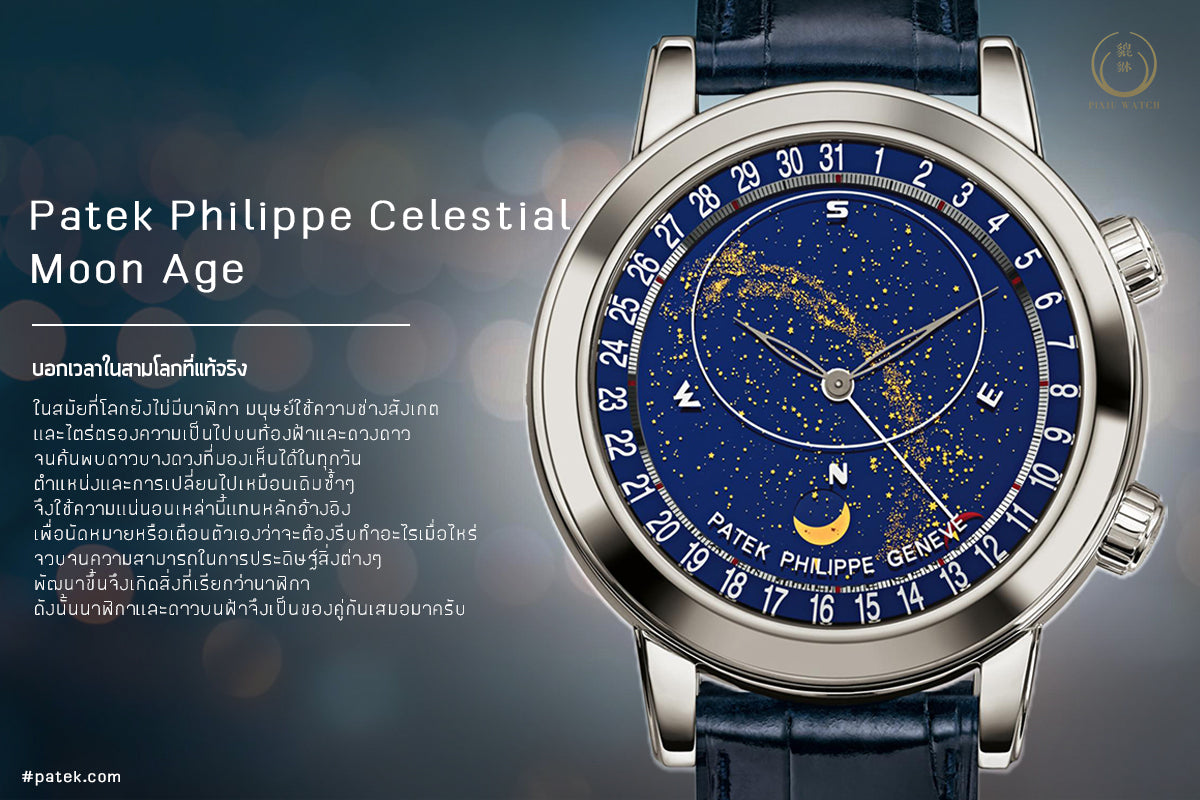
New: Patek Philippe Celestial Moon Age, telling true time in three worlds.
In the days before the world had clocks, humans used observation and contemplation of the heavens and stars to discover certain stars visible every day. Their positions and unchanging, repetitive transitions allowed these constants to be used as reference points for appointments or to remind oneself of when certain tasks needed to be done. It wasn't until the development of our ability to invent various things that the clock was created; thus, clocks and the stars in the sky have always been partners.

Patek Philippe 6102P Celestial Moon Age is a watch with a high—a truly high—level of timekeeping functionality that we use to reference astronomical functions. Its dial indicates time based on constellations and the 24-hour cycle defined by humans, providing astronomical timekeeping via the Sky Chart, Time of Meridian Passage of Sirius, and Time of Meridian Passage of the Moon.

The dial depicts the night sky over Geneva from the perspective of the Northern Hemisphere. Simply put, if you stand upright and look directly overhead, the view you see is this angle. When you gaze steadily upward, the boundary of your field of vision is the oval line drawn on the dial, which is known in astronomy as a “Planisphere.” To use it, find an open area—somewhere high up, like a mountain peak, is even better. Stand there, face north, and carefully rotate the watch to align with the cardinal directions. Hold the watch above your head, with the dial facing downward toward the sky behind you. If you look up, you will see the star map on the watch dial align with the actual sky. From there, it is time to have fun tracing the stars in comparison to those in the heavens. It is easiest to use if you try it under the skies of Geneva. This is the functionality known as the “Sky Chart.”

Next is a function that isn't built into the watch but requires us to act as part of the function: the meridian, an imaginary line used to divide time zones on Earth. After playing with the star-viewing feature of the 6102P, before moving on to the next function, we must treat ourselves as a reference point for time. Stand still and imagine a line drawn from North to South, passing through the highest point directly above your head. When the sun is at the meridian line created by our reference point, it is noon in that locality. This is why "A.M." (Ante Meridiem) means before noon and "P.M." (Post Meridiem) means after noon. Once you have established yourself as a meridian line, let’s go and enjoy the next function.

The "Time of Meridian Passage of Sirius," or what we Thai people call the "Thief Star," is named because this star is so bright that it historically allowed thieves to work comfortably at night.
Sirius is the brightest star and the one closest to Earth in the Canis Major constellation. One orbital cycle of this star passing through the meridian is exactly 23 hours, 56 minutes, and 4 seconds. This movement is the most precise and unchanging. Therefore, this duration of 23 hours, 56 minutes, and 4 seconds is considered a "Sidereal Day," whereas a 24-hour day is called a "Solar Day," which is the average time it takes for the sun to move to the center of the meridian, or noon. Now, the way to read the Sidereal Day is to locate the "thief star" on the dial—it is the largest star—and once you find it, you will see an arrow underneath pointing to a scale divided into 12 large increments and 288 sub-increments, used in conjunction with the Sidereal Day indicator arrow.

The "Time of Meridian Passage of the Moon" counts time based on the moon passing through the meridian, similar to the thief star. However, because the moon orbits the Earth while the Earth orbits the sun, the time calculated from the moon is exactly 24 hours and 50 minutes each day, just like the star. Many cultures, such as the Chinese, count days based on the movement of the moon, or the lunar calendar. The 6102P can also display time in this system by using the moon on the dial and the arrow pointing to the same scale used for the thief star.
Moon Phases: Naturally, when telling time based on the moon's movement, a "Moon Phases" function is included. Moon phases occur as the sun obscures the moon from our perspective on Earth, and one full lunar cycle equals 29.53 days. The 6102P uses the same lunar display to show these phases.

As you can see, each function has its own unique time value that does not overlap. This watch is therefore categorized within the upper echelons of the Grand Complications group. By utilizing three independent working discs to display the Sky Chart, the Meridian passages of both the thief star and the moon, and the moon phases, it even includes a date function indicated by a crescent-moon hand. If any of you are lucky enough to have one in your collection, try taking it out to observe the stars on your day off. You will feel a deeper sense of enjoyment and appreciation for this elite-level timepiece from Patek Philippe. Best regards.
++++++++++++++++++++++++++++++++++++++++
🔺 Interested in other authentic pre-owned Patek Philippe watches? Click here 🔻
++++++++++++++++++++++++++++++++++++++++
References:
-https://www.patek.com/en/collection/grand-complications/6102P-001
-WatchBox Review : https://www.youtube.com/watch?v=4iXURj5VMhQ
-https://robbreport.com
http://www.pw.ac.th
-https://en.wikipedia.org/wiki/Solar_time
-https://en.wikipedia.org/wiki/Sidereal_time